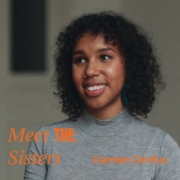
THE:Interview – Olga Kosanović
/in Blog /by The Sorority
Noch lange keine Lipizzaner
In Austria almost 28% of the population has a migration background. In Vienna it’s 50%*.
Despite the fact that Austrian society is actually very diverse, integration and naturalization are a struggle. This was also the case for director Olga Kosanović, who, although born and raised in Austria, has not yet been able to obtain citizenship. When her situation was picked up by the media, readers were quick to reach.
“If a cat gives birth to kittens at the riding school, that doesn’t make them Lipizzans”, wrote one user under an article. A sentiment that many people with migration backgrounds have probably been confronted with.
But what is it that makes people react so strongly to this idea of national identity and what does it mean to belong? These are some of the questions that lie at the heart of “Noch lange keine Lipizzaner”, Olga Kosanović’s debut feature film that hits Austrian theatres starting the 12th of September and that will also be presented on the 15th of September as part of our feminist film club (event here).
Olga took the time to sit down with us and talk about identity, belonging and how we should all more often go outside our comfort zone and speak to the people next to us, no matter how different we might think we are.
Sorority: The film is based on your personal experience applying for Austrian citizenship. What was the moment when you thought, “Okay, I want to turn this into a film?”
Olga: To be honest it was a long process before I decided to actually make a film about it. But looking back, the initial moment was probably when I supported a campaign by SOS Mitmensch, who wanted to make citizenship more accessible for people born in Austria. I recorded a short video to support them and suddenly it went viral for two days. That wasn’t at all planned.
Suddenly I was in the media, with a lot of articles everywhere about my case, on how it is possible that I didn’t have citizenship even though I was born here. Then I started reading all the online comments and at first was really surprised by the amount. One article had over 800 comments. I was just struck: Why are 800 people interested in whether I get citizenship or not?
Some people were shocked by my case. Others were emotionally moved, but said, “of course she can’t get it, it shouldn’t be easy” and “it’s not for everybody.” All these emotions online really interested me and I thought, maybe there’s more to it. That’s when I got the idea that there is a broader audience for a story like this.
Sorority: And how did the concept evolve? The film mixes so many forms and perspectives. Was that your plan from the start or did it come together with your crew?
Olga: It was very much a flowing process. First, to decide to make a feature-length film and figure out how to finance it and present it to funders. I started researching, talking to a lot of people, some who had similar stories, but also to lawyers, political scientists, people who understood Austrian society and Austrian history. I quickly noticed that the topic has so many different facets, like belonging, identity, history. Austria has a very complex history of nation-building. All of this comes together.
It also has a lot to do with my crew as well. In the research process I ended up with a whole shelf of books connected to the film because the topic is very broad. So in order to not feel overwhelmed by it, we decided to make a mind map of all the topics that get talked about even for a little bit. There were only four of us in the core team and we just brainstormed together and had all these little ideas that we pieced together like a puzzle.This gave us a lot of freedom. We could go from one topic to another and back again. and it was very freeing, the form didn’t have to be very strict so everything was possible: to include fiction, animation, documentary interviews. It was also a lot of fun.
Sorority: What was it like, sharing your personal experience with the crew, people who might have not had the same experiences?
Olga: The film actually came to life only because of the crew. There were a lot of times when I struggled with the fact that I’m part of the story and for a long time I refused to be the protagonist because I thought it’s not important. What’s important is the topic. I thought my role was just to tell the story and interview others.
But my crew really encouraged me to include my own experiences and feelings. Also when I was pitching the project, funders often said, “Your story is such a good example of how badly the laws work”. So I thought if I become the protagonist, I can become the figurehead for this topic and represent people with similar stories. It was always very important to me that the film wasn’t only about me or whether I got citizenship, but that my journey opened a bigger conversation.
Sorority: The topic is very loaded: identity, belonging, “us versus them,” othering. Were there things you felt were essential to include, or certain tones you wanted to avoid?
Olga: It was very important from the beginning that we don’t lose the lightheartedness. Very often when you hear this topic being discussed in public it’s always somehow in a negative or aggressive way. Or it’s weaponized in political discourse, but it’s never really talked about and many people lack knowledge about it. Myself included, when I first started.
When I told people I was making a film about citizenship law, they’d roll their eyes: That’s so dry and boring. So the challenge was to make a film that could be entertaining, but that could also guide you through important current issues. But I think it’s really important that it doesn’t lose its lightness or makes people feel hopeless.
Sorority: As you say, lightness is something that is often missing when it comes to this topic. For example, some of the comments under your SOS Mitmensch were very inflexible in tone: “These are the rules, these have always been the rules and they apply to everyone. This is how it should be”. Were you faced with any of this rigidity when interviewing people for the film?
Olga: There were harmonious parts but there were also frustrating moments, especially in the beginning of my journey.. I wanted to close the laptop and put it away, I didn’t want to have anything to do anything with it anymore.
But the topic kept coming back to me. Friends who’ve known me my whole life couldn’t believe this could happen in Austria. I couldn’t believe it either and asked myself, “why are the laws the way they are? What emotions are behind these comments? Where are they coming from actually?”
Sorority: Where are they coming from?
Olga: I researched a lot about Austrian identity and the history of Austrian identity and part of it is also this inclination towards following the rules.” If this is what the rule is, then it must have a reason, it must make sense”. There were many people I talked to that said, “there is a system, why would it be there if it’s not right?”.
But it’s very important that we rethink things that are normal today and ask ourselves if they’re still applicable to today’s reality. A lot of the people that I talked to don’t have bad intentions when they say, “I think it’s good as it is”. But interestingly, when I asked them to elaborate, they struggled.
Sorority: Realizing, “I actually don’t know”.
Olga: Yes, exactly. Suddenly there was a tiny realization of, I never questioned my own thinking. It’s just something I inherited from my parents, from my bubble, the media.
It was very important to me to deliver this message, that regardless of the bubble we’re in, we have to fact-check ourselves. This is what makes a discussion with someone different than you possible.
Sorority: It’s easy to start thinking our own bubble is all there is.
Olga: Yes. This is why it was very important to us to find people outside of our bubble for the interviews. To get out of our comfort zone and go to a bar we never would have entered and just start speaking to people.
Sorority: The film really drives this point of being open instead of focusing on inflexibility or assimilation. Often the expectation for people with migration backgrounds is very inflexible: you must assimilate.
Olga: Yes. This was also my childhood experience in Austria: assimilation. I didn’t get this idea from my parents, they never said, “Beware, you have to assimilate”, but I wanted to because I wanted so much to belong. I didn’t want to be the outsider, the foreigner. During my childhood I was ashamed of speaking my language in public or in front of my friends. It took a long time for me to build my identity on both grounds, let’s say. It has to come from within and it’s a lot of work. This is something I really wish for the future, that all these migrant biographies have more space to be who they really are and not change themselves to belong.
I personally learnt this in my late 20s, but I also interviewed a lot of young people and many of them were so inspiring. They had self-esteem related to their background. I felt a bit of optimism that maybe this will change. The younger generation is like, “I’m Sudanese and Austrian. I’m both”.
Sorority: Yes. Assimilation changes you, also in some way you don’t even notice, it is like splitting yourself. Hearing that younger people can say: “I’m both and I belong both here and there” sounds really hopeful.
Olga: Yes, exactly. I only learned that through the film, by finding others with similar biographies. But this was something I had to do on my own: finding the people, finding the stories. I’d like my child to grow up in an Austria where these narratives are more accessible,
We need these kinds of stories in order for people, for kids to be able to say, !Ah, this is like me. I understand these feelings, so it’s okay to feel like this!. I didn’t have that when I was younger, I think it’s really important.
Sorority: My last question: What would you wish that someone from the audience feels or thinks after leaving the cinema, watching your film? Regardless of their passport.
Olga: You made an important point here because the film is not only for people who struggle getting citizenship, it’s for all of us. Also for the Austrians that have been Austrian for generations. That was one of our aims, that people think, “this has something to do with me as well.” So this would be the first goal: if somebody who has never struggled with citizenship goes to watch the film and afterwards thinks, “That was interesting. We need to rethink some of these things.”
And I hope the film doesn’t leave people angry. Frustrated, but not angry in a way that shuts them down, “I don’t want to see or think about this”. The film is more like an attempt to reach out the hand and say, okay, let’s talk to each other, work it out and maybe even party together in the end.
Thank you, Olga, for this lovely interview and even lovelier film!
written by Diana Mereoiu
Further information and sources
Foto © April April
Trailer Noch lange keine Lipizzaner
Statistik Austria Migration und Einbürgerung
 Ursula Schmitz
  Omas gegen Rechts